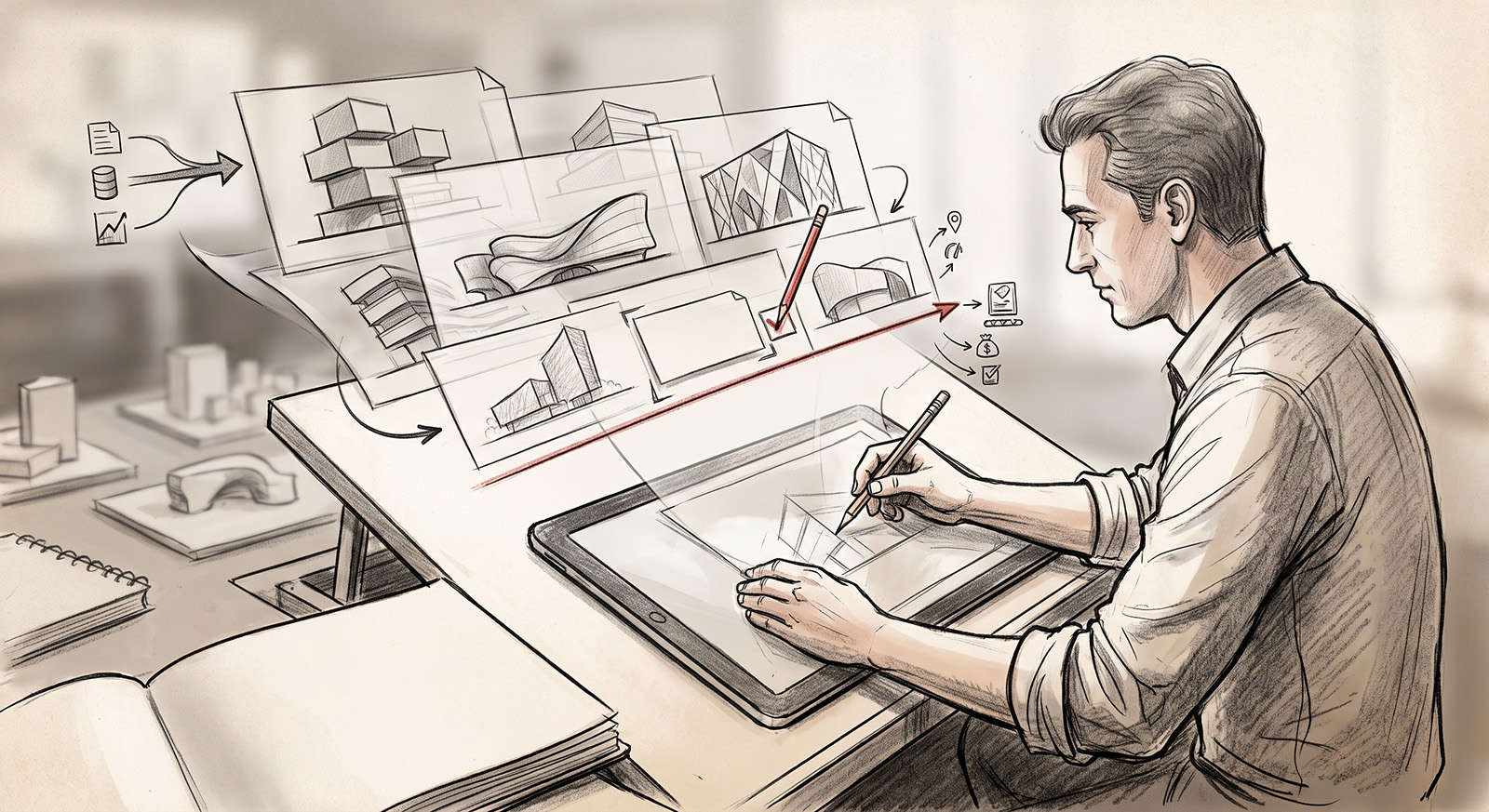
For hundreds of years, an architect was a maker. To design meant to touch materials: pencil on paper, wood models on a desk, and slow, careful lines drawn by hand.
Today, an artificial intelligence can create 100 room layouts, building facades, and 3D shapes in ten seconds. Because the computer generates forms so fast, we face an existential question:
If the machine makes everything, what is the human for?
Many say the architect is now just a curator—someone who looks at images and picks the best one. But if curation only means clicking on pretty pictures, architecture loses its soul.
To survive, architecture must understand what craft really is: not just moving hands, but giving meaning to choices.
The Blind Machine: The “Selection Problem”
A computer can beat a grandmaster at chess, but the computer does not know it is playing a game. It has no feelings, no memories, and no idea what warmth or sunlight feels like.
When an AI generates 100 building plans, 99 of them might be structurally safe and look beautiful. But how do we decide which one is right?
This is the Selection Problem.
A machine can answer how to shape a wall. But only a human can answer why that wall belongs in this neighborhood, for these people, at this moment in history.
Choosing is not a shortcut; choosing is a heavy moral responsibility. If a building feels cold, lonely, or unsafe, the architect cannot blame the code. The architect must stand in front of the community and defend the choice.
The Extended Mind: Two Kinds of Curation
Philosophers note that when a blind person walks with a white stick, the stick is no longer just wood—it becomes part of their body. The person “sees” through the stick.
Writer Neil Leach says AI is like this stick: it is an extended mind. AI is not an outside enemy taking our work; it is an extra layer of human thought.
Because of this, curating happens in two different ways:
- Curating the Results: Looking at the 100 designs and judging them with human empathy and local context.
- Curating the Tools: Deciding how the computer thinks.
Think of a painter choosing a fine brush versus a wide palette knife. The tool is not passive; the tool shapes the imagination before the first drop of paint hits the canvas.
When an architect chooses which AI model to run, they are designing the rules of thought. Choosing the tool is the first act of design.
The Rise of the “Meta-Designer”
This transforms the craft:
- The traditional maker focused on drawing the object.
- The careless user accepts whatever the algorithm spits out.
- The meta-designer designs the system, guides the questions, and checks the results with wisdom.
Craft was never just about muscle memory in our fingers. Craft has always been about care, judgment, and purpose.
Beyond the Screen
When paper was invented, people worried memory would die. When computers arrived in studios thirty years ago, people feared drawings would lose their heart.
Now, in an age where images cost nothing to make, the most valuable thing an architect owns is not drafting speed. It is the quiet wisdom to say: “The machine made 100 forms, but this is the only one that honors human life.”