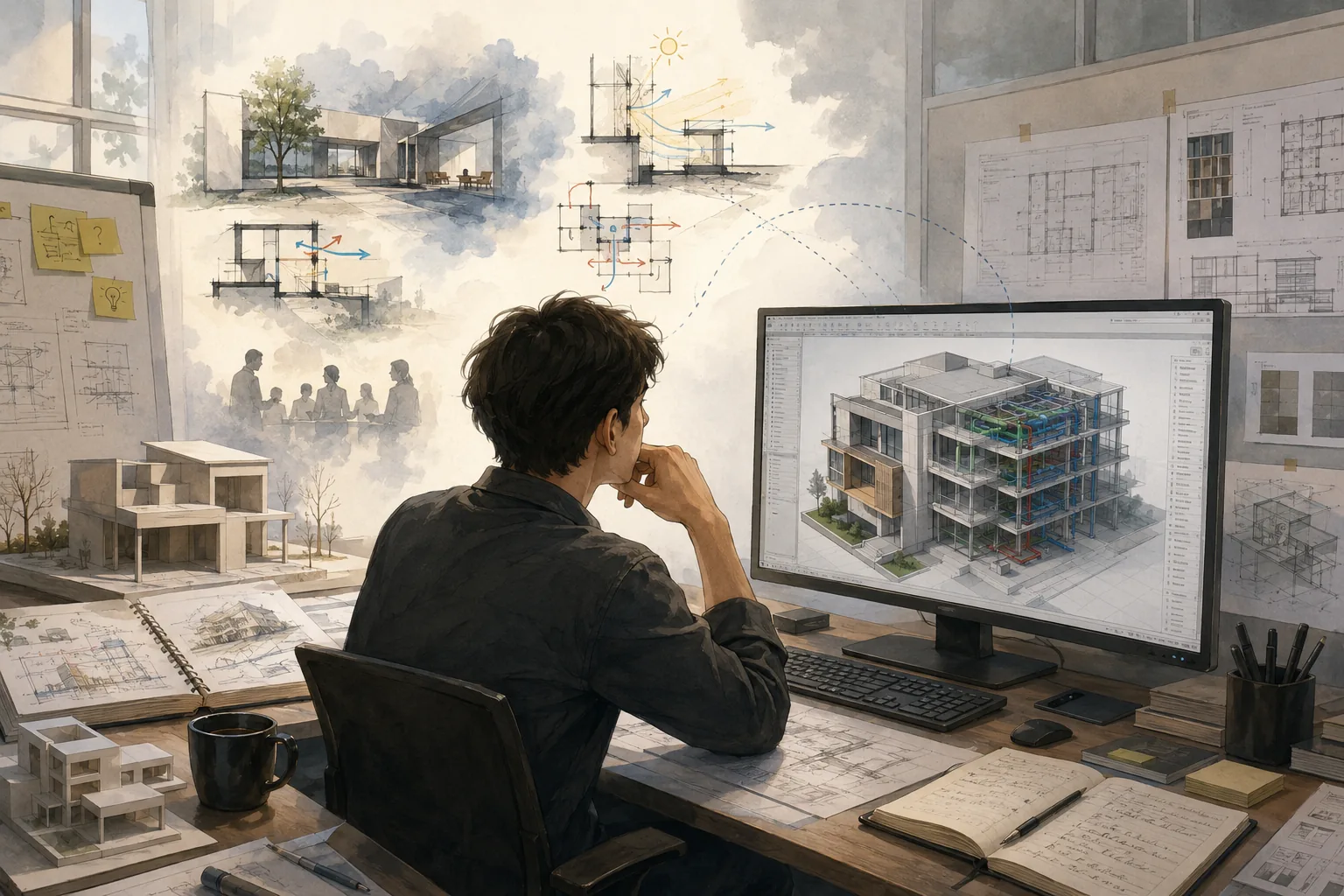
BIM is very good at describing buildings. A BIM model can store dimensions, materials, quantities, systems, and technical data. It can also help architects coordinate drawings, find clashes, and manage project information.
However, BIM is less effective at representing one important thing: design intent.
A model can show where a wall is located. It can store its thickness, material, fire rating, and other properties. But it usually does not explain why the architect placed the wall there, which options were considered, or what design value the decision was meant to protect.
BIM remembers what we decided. It does not always remember why.
Design begins with uncertainty
Architectural design rarely begins with a complete answer. It often starts with questions, rough sketches, unclear ideas, and several possible directions. Architects need time to explore these possibilities before making final decisions.
BIM works differently. A BIM model needs clear objects and information. A wall needs a type, a room needs a boundary, and a parameter needs a value. This structure is useful because it helps architects create coordinated and reliable information.
Problems can appear, however, when this level of definition comes too early. An architect may begin choosing wall types, materials, and dimensions before the main design idea is clear. The model becomes more detailed, but the design may still be weak.
A precise model does not always mean a mature design.
Information is not the same as intention
BIM is often described as an information-rich process. This is true, but more information does not always lead to more understanding.
For example, a BIM model may store a window’s size, material, cost, and thermal performance. But it may not explain that the window was placed to frame a view, bring morning light into a room, protect privacy, or create a visual connection with a garden.
These intentions may exist in sketches, diagrams, meetings, or the architect’s memory. They are important parts of the design, but they are often not stored in the BIM model.
The model represents the window. It does not fully represent the reason behind the window.
The appearance of certainty
BIM can make a project look clear and complete. Drawings are coordinated, objects are aligned, and data is organized. Changes in the model can also appear automatically in plans, sections, schedules, and other views.
Because the model looks precise, we may begin to believe that the design is also fully resolved. This can be misleading. A detailed object may still come from a poor decision, and a coordinated model may still represent the wrong idea.
BIM does not force architects to make decisions too early. However, its structure can encourage us to define things before we have explored them enough.
Every design tool affects how we see a problem. BIM sees a building as a system of objects, properties, and relationships. This is useful, but it cannot represent every part of architecture equally well.
Some architectural qualities are easy to measure. Others, such as atmosphere, memory, meaning, and spatial experience, are much harder to place inside a parameter.
BIM is not the problem
This is not an argument against BIM. BIM is an important tool for architectural coordination, documentation, construction, and building management.
The problem begins when we assume that the BIM model contains the whole design. It does not.
A building model can explain what will be built. A design process should also help us understand why it should be built in that way.
Architects therefore need other forms of representation. Sketches, diagrams, physical models, written notes, and design alternatives can preserve ideas that BIM cannot easily store.
The goal is not to replace BIM. The goal is to understand what BIM can represent well and what still needs other tools.
Keeping the reasons behind decisions
We do not need to place every design thought inside the BIM model. That would make the process more complicated and create more unnecessary information.
However, important decisions should not lose their reasons. A project team can record the problem behind a decision, the options that were considered, the reason for choosing one option, and the architectural value that should be protected.
This information becomes especially useful when a project moves from one person or team to another. A decision may be clear to the original architect, but without an explanation, another person may see it as unnecessary or arbitrary.
When the reason disappears, the decision becomes easier to change or remove.
Beyond object modeling
The future of BIM should not only be about adding more objects, data, and automation. It should also help project teams understand important design decisions.
A wall should still be represented as a wall. But the project record could also explain what problem the wall solves, which options were explored, why the final option was selected, and what architectural quality it protects.
This is not only a software problem. It is also a question of how architects think, communicate, and remember.
Perhaps BIM should not only support object modeling. It should also support decision modeling.
What should BIM remember?
BIM represents buildings well because buildings can be divided into objects, systems, properties, and information. Design intent is more difficult to represent because it can change during the project and may come from discussion, experience, intuition, and judgment.
BIM may never represent every part of architectural thinking. But it should help us preserve the reasons behind important decisions.
A building is more than a collection of modeled objects. It is also the result of decisions about people, place, space, performance, and meaning.
BIM can tell us what a building contains. A better design process should also help us remember why those things are there.