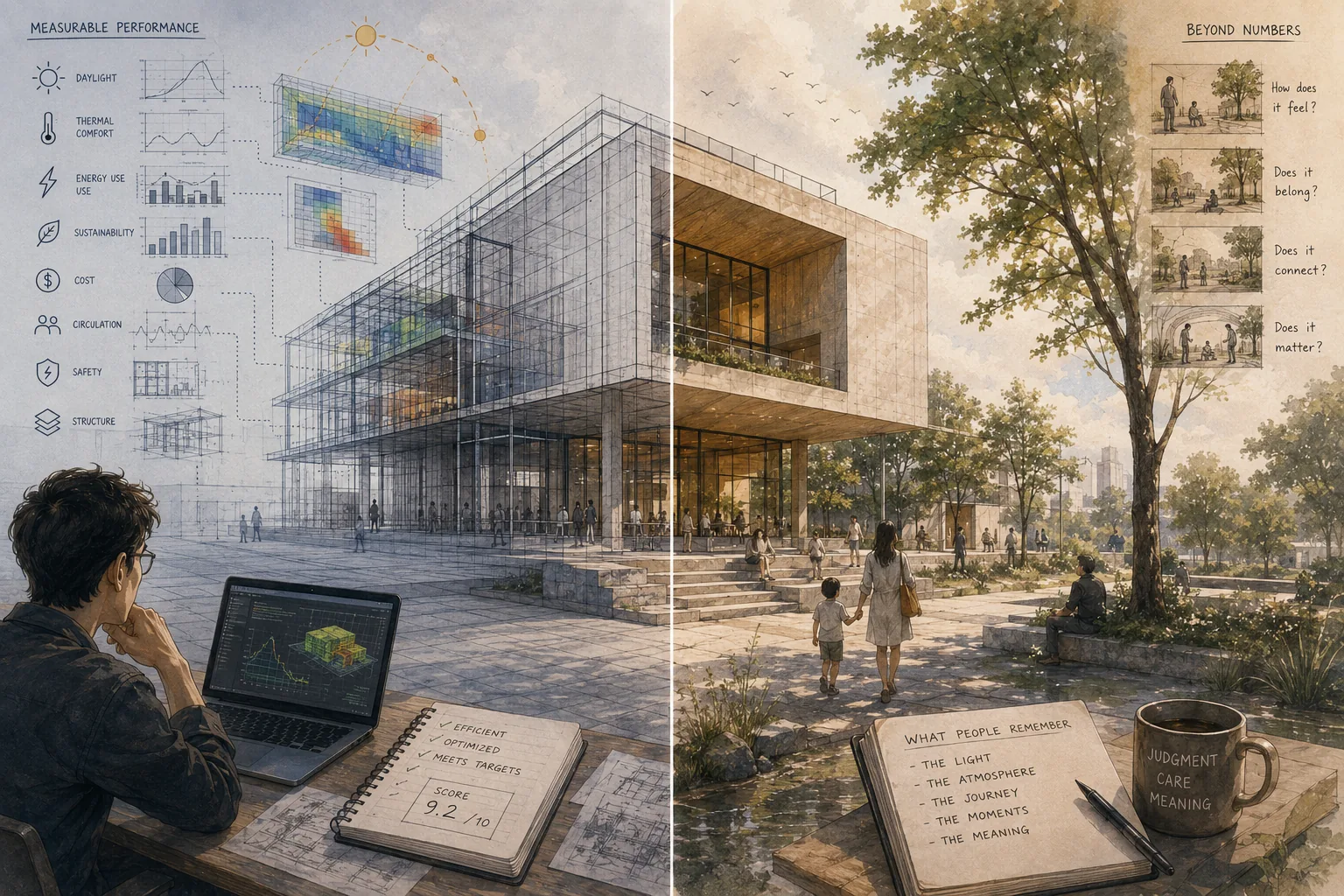
Today, architects can measure buildings in more detail than ever before. We can calculate energy use, daylight, temperature, structure, cost, circulation, and many other factors. Digital tools help us compare different options and find solutions that perform better. This is important progress because buildings should be safe, efficient, comfortable, and responsible toward the environment.
But good performance does not always create good architecture. A building can meet every technical target and still feel cold, confusing, or out of place. It may work well on paper but fail to create a meaningful experience for the people who use it.
What we can measure
Many parts of a building can be measured. We can study how much daylight enters a room, how much energy the building uses, or how quickly people can reach an exit. We can compare materials, calculate costs, and predict indoor comfort. These measurements help architects make better decisions and reveal problems that may be difficult to see through intuition alone.
For example, a room may look bright in a rendering but receive too much heat during the day. A glass façade may look elegant but create high energy use, while a simple floor plan may produce long and inefficient walking routes. Data helps us see these problems more clearly and test possible solutions.
The danger begins when we assume that everything important can be measured in the same way.
What numbers cannot fully explain
Architecture is not only about technical performance. It is also about how people feel, move, remember, and connect with a place. A room may have the correct temperature and enough daylight but still feel uncomfortable. A public space may have efficient circulation but feel unfriendly, and a house may use very little energy but fail to give its residents privacy, warmth, or a sense of belonging.
These qualities are difficult to turn into numbers. We can measure sound levels, but not always whether a space feels peaceful. We can measure the size of a window, but not fully explain the emotional effect of seeing a tree, a street, or the morning sky through it. We can also calculate how people move through a building, but not always what they feel during that movement.
This does not mean such qualities are mysterious or impossible to discuss. It means they need more than numbers. They also require observation, experience, conversation, and judgment.
When performance becomes the main goal
Digital design tools often encourage us to optimize. We define a goal, test several options, and choose the one with the best result. This process is useful when the goal is clear, such as reducing energy use or improving daylight. In those cases, optimization can help architects find better solutions.
But architecture rarely has only one goal. A larger window may bring in more daylight, but it may also reduce privacy. A more efficient circulation route may remove moments of pause and discovery, while a highly optimized building form may perform well but feel disconnected from its surroundings. Every design decision includes several values at the same time, and not all of them can be measured.
The option with the highest score is not always the best design.
A building is experienced as a whole
People do not experience buildings as separate performance results. They do not enter a room and think about its energy score, daylight percentage, or structural efficiency one by one. Instead, they experience the room as a whole, where light, sound, material, scale, temperature, memory, and meaning come together.
This is why architectural quality cannot be reduced to a checklist. A small weakness in one area may be acceptable if the space offers something valuable in another. A building is more than the sum of its technical parts, and those parts must work together to create a meaningful experience.
A building may perform well according to every measurable standard and still feel wrong because its parts do not create a convincing whole.
The role of architectural judgment
As digital tools become more powerful, architectural judgment becomes more important, not less. Software can provide information, simulate performance, compare options, and show patterns that architects may not notice. But it cannot fully decide what kind of place people need or what qualities should matter most.
Those decisions require architects to understand people, culture, context, and the purpose of the building. The role of the architect is not to reject data, but to place data within a larger understanding of architecture. Good judgment asks not only whether a building performs well, but also whether it supports the lives of its users, belongs to its place, and creates comfort, dignity, and meaning.
These questions may not produce simple scores, but they still matter.
Beyond what we can measure
We should continue measuring building performance. Better data can help us create safer, healthier, and more sustainable architecture. But measurement should support design, not define its full value.
Some of the most important qualities in architecture cannot be fully captured by a model, a simulation, or a spreadsheet. They appear through experience: in the way light changes during the day, in the feeling of entering a quiet room, or in the connection between a building and its surroundings.
A building can perform well and still feel wrong. The challenge for architects is not to choose between data and intuition, but to use both. We need to understand what numbers can tell us while remaining aware of what they leave out.
Good architecture needs performance, but it also needs judgment, care, and meaning.